

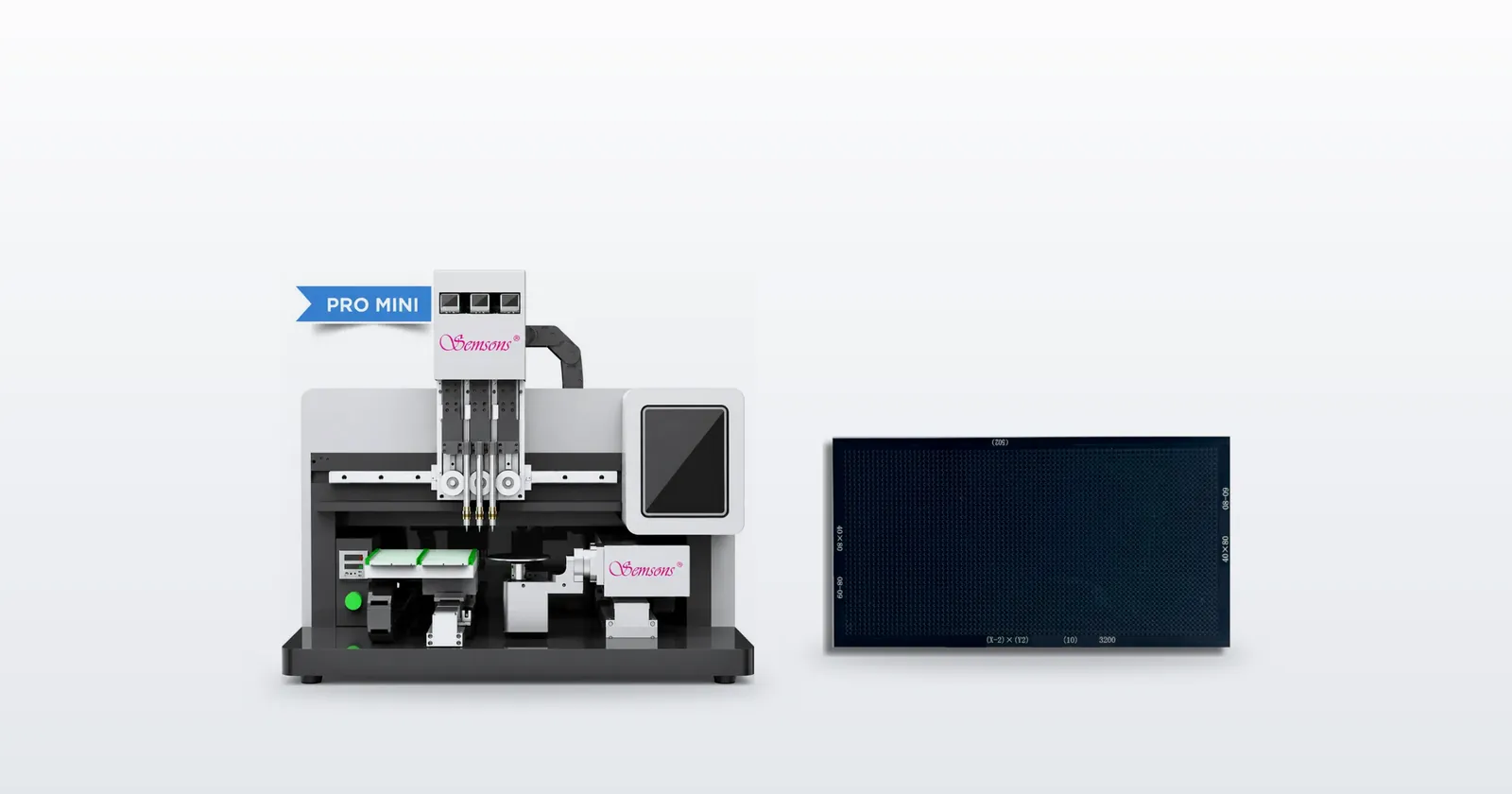
Diamond setting cost per stone is what you pay for a stretch of setting work divided by the stones set in it. For a hand setter that is a day's pay, overheads and rework, divided by the stones set that day. For a machine it is a month of machine, operator and running costs, divided by the stones it sets that month. Work both out with your own numbers and the cheaper method shows itself.
We do not publish wage rates or job-work prices: they change by city, skill and stone, and any figure we printed would be wrong for someone. What we can give you is the method, the costs people forget, and the published facts for our machines.

How much does stone setting cost?
If you searched for a stone setting price list, you will have noticed there is no standard one. Rates depend on:
- Stone size and style. Tiny pavé stones, prongs, channels and bezels take different time.
- How setters are paid. Per day, per piece or per stone, each hides costs differently.
- Where the work is done. In-house, with your overheads, or outside as job work, with someone else's margin and queue.
- Quality you accept. A fast rate with loose or tilted stones is not cheap once rework is counted.
That is why the useful number is your cost per stone, worked out the same way for every option.

Step 1: your hand-setting cost per stone
| Input | Where to find it |
|---|---|
| Setter pay for one day | Your payroll, or the job-work rate you pay |
| Overheads per setter per day | Bench space, lighting, tools, supervision |
| Rework and lost stones per day | Pieces sent back for loose, tilted or missing stones, and stones replaced |
| Stones set in one day | Count a normal day on your usual designs, not your best day |
Cost per stone = (pay + overheads + rework) ÷ stones set in the day. Do it for each setter, or for an average day across the bench.
The costs of hand setting that do not show on the payslip
- Rework. Every loose or tilted stone found after casting costs metal, labour and a rework slot.
- Late orders. When setting is the slowest stage, the whole order waits for it.
- Training and turnover. A new setter takes a long time to reach full speed, and a skilled one can leave.
- Uneven finish. Stones set at slightly different depths and angles look different across a bulk order. Our store sheet for the X4 Pro Plus says machine-set stones show better gloss and fire because every stone sits at the same depth and angle.
Step 2: your machine cost per stone
| Input | What to use |
|---|---|
| Machine cost for a month | From your quotation, spread over the months your accountant uses |
| Operator pay for a month | One trained operator per machine; our engineers train them on site |
| Consumables | Suction nozzles (they wear and are replaced), setting putty, mounting bases, sorting trays |
| Power and air | Rated power 1.3 kW (Pro Mini), 2.5 kW (X4 Pro Plus, 3 kVA peak), 3.5 kW (ST-HDSSM); plus a compressor and air dryer |
| Stones set in a month | Your real stones per hour × hours × working days, measured on your own waxes |
Cost per stone = (machine + operator + consumables + power and air) ÷ stones set in the month.
Use a real rate, not the rated maximum. The machines are rated at up to 10,000 stones an hour on the Pro Mini, up to 15,000 on the X4 Pro Plus and up to 20,000 on the ST-HDSSM, but your designs, stone sizes and wax decide the real figure. For the machine price itself, see our guide to what drives the price of a diamond setting machine.
Diamond setter salary: what to compare
When people compare a diamond setter salary with a machine, they often compare a monthly wage with a machine price. That leaves out the most important number: how many stones each one sets well. A setter's daily pay divided by the stones they set in a day, and a machine's monthly cost divided by its monthly output, are the two numbers to put side by side.
Our store sheets say a Pro Mini does the work of about 10 skilled setters and an X4 Pro Plus 10 to 12; our catalogue puts the ST-HDSSM at roughly 15. Treat those as our published claims and check them on your own designs. You will still need setters for centre stones, heat-sensitive gems and repairs; the machine takes over the small, repeated round stones.
Check your numbers before you decide
- Count your stones. The setting machine calculator on our category page turns pieces per month and stones per piece into the stones per hour you need, and compares every machine.
- Get a quotation for the machine that fits, with what installation and training include.
- Watch your own designs set. A demo on your waxes gives you the real stones per hour to use in step 2.
If you are short of setters right now, our guide to hiring setters, job work or a setting machine compares the three options, our diamond setters page shows which machine takes that work off the bench, and wax setting vs hand setting explains where each one wins.
Watch it explained in your language
Prefer Hindi, Gujarati or Bengali? Pick your language and WhatsApp opens with your request. Our team replies with a video that explains this machine and how it works.
- हिन्दी · Hindi यह मशीन कैसे काम करती है, इसका वीडियो हिन्दी में WhatsApp पर पाएँ।
- ગુજરાતી · Gujarati આ મશીન કેવી રીતે કામ કરે છે તેનો વિડિયો ગુજરાતીમાં WhatsApp પર મેળવો.
- বাংলা · Bengali এই মেশিন কীভাবে কাজ করে, তার ভিডিও বাংলায় WhatsApp-এ পান।
- English Get the video explanation in English on WhatsApp.
Where to see and buy it
These are the Semsons Tech automatic wax setting machines. Each link opens the full specifications and a quotation request.
| Machine | Rated speed and power |
|---|---|
| Pro Mini | Up to 10,000 stones an hour 1.3 kW, single-phase 220 V |
| X4 Pro Plus | Up to 15,000 stones an hour 2.5 kW rated, 3 kVA peak, single-phase 220 V |
| ST-HDSSM | Up to 20,000 stones an hour 3.5 kW, 220 V |
| PRO SERIES | Datasheet on request |
Bring your designs and your numbers. Book a demonstration at our Mumbai or Rajkot office, at your workshop or live on video, or call +91 98216 12340.


